
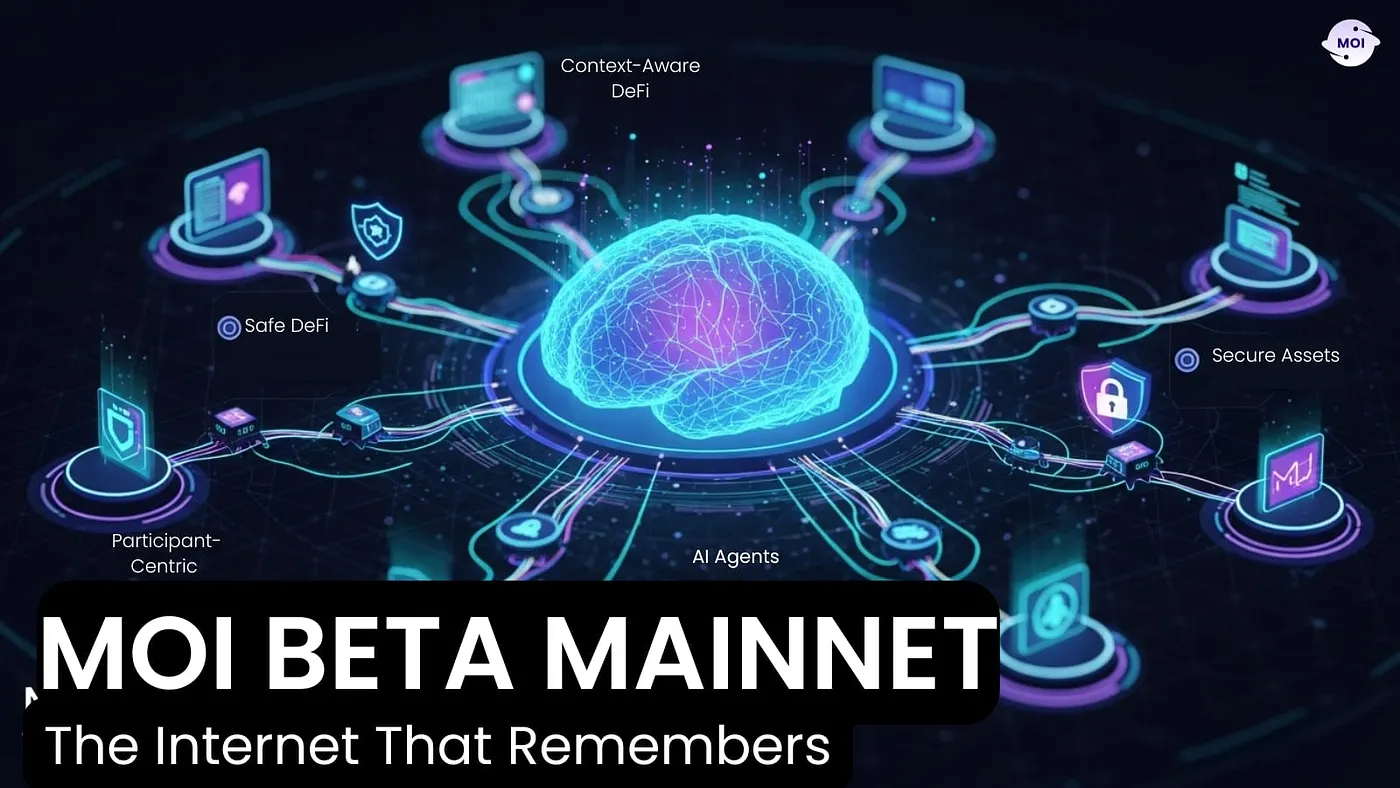
The wait is finally over! The world’s first thinking network is alive. On October 2nd, the MOI Beta Mainnet launched and the internet itself got an upgrade!
For decades, the web has carried our messages without understanding them. It could move emails, payments, and photos, but the pipes underneath stayed dumb. They never knew who you were, what you were doing, or why it mattered.
MOI changes that. It is the first network built around context. Every interaction understands the participant involved, the assets in play, and the rules or preferences tied to them.
Imagine hailing a cab to the airport. On today’s internet, the ride app books your car, the payment app charges your card, and the airline app tracks your flight, but none of them coordinate. You end up with the driver arriving too early, your card getting flagged for suspicious activity, and your boarding pass buried in another app.
On MOI, the network itself remembers the whole situation. The driver shows up at the right time, the payment clears instantly because it knows it is you, and your boarding pass is already linked. Everything works together because context travels with you instead of dying in silos.
That is what it means to launch a thinking network.
Why MOI, Not Another Blockchain
Every blockchain until now has been system-centric — organizing around global ledgers and shared contracts. This forces everything to coordinate globally, creating the bottlenecks, high costs, and isolated silos we’ve all lived with. MOI is the first participant-centric network. Context lives with you — your assets, preferences, and interactions travel together. This eliminates the need for global coordination, which is why agents can finally coordinate, payments adapt to context, and enterprises can run real workflows. It’s not better blockchain — it’s blockchain built on the right foundation for how value actually works.
Network Launch Details
MOI is not starting from zero. The Beta Mainnet launches on top of a network that already runs with more than 2,000 nodes worldwide and over 100 applications building. That means developers are not waiting for adoption to start, it’s already happening. Early projects like Xoog.ai, Kapsul.ai, and Iome.ai are live, showing how a thinking network powers everything from unstructured data storage to agent-driven apps.
Safe DeFi, Finally
DeFi today feels like leaving everyone’s money in one giant swimming pool and hoping no one jumps the fence. Billions have been drained because once the pool cracks, everything floods.
MOI does it differently. Assets are native and live with participants, not in pooled contracts. Picture it like every dollar staying in its own wallet instead of being thrown into a shared vault.
That coffee purchase on your way to work? Cleared instantly. That five-thousand-dollar television? The network adds extra checks automatically. Payments adapt to the context, just like a human cashier would.
Safe when it needs to be strong. Frictionless when it should be simple. That is what Safe DeFi looks like on a thinking network.
Agentic Agents
AI agents are everywhere now. They can book flights, write emails, or even buy tickets. Each one looks clever on its own, but they do not talk to each other. Your travel bot books a flight, but your calendar bot does not warn you that it overlaps with your kid’s recital. Your ticket bot finds a show, but your hotel bot books the wrong night. Smart services, dumb coordination.
MOI fixes this through Safe Agentic Coordination. Because context lives at the participant level, agents no longer invent memory or guess. They all read from the same playbook.
That means your ticket agent, hotel agent, travel agent, and babysitter agent actually work in sync. No copy-pasting, no scrambles, no disappointed Swiftie in the back seat.
Enterprise Adoption On Demand
Enterprises have circled blockchain for years, but most systems forced them to rebuild their entire business inside rigid contracts. Accounting flows had to be rewritten line by line, compliance rules had to be bolted on with fragile oracles, and every upgrade felt like surgery on a live system. No wonder adoption stalled.
MOI was built differently. It is context-aware at the network level. That means every interaction understands who the participant is, what assets are involved, and what rules apply. For enterprises, this translates into workflows that mirror the real world instead of being jammed into brittle code. Payroll, accounting, supply chain, or compliance checks can all run directly on participant context, so the business logic travels with the company instead of being trapped in a contract.
The compute layer, Coco, acts like the conductor, making sure each part of the enterprise stays in sync, while PISA provides the sheet music, ready-made modules in plain JavaScript for actions like payments, asset transfers, and agent orchestration. Developers do not need to learn obscure languages or reinvent their workflows. They can extend what they already have, plug into MOI, and build quickly with confidence.
This is not just potential. More than 100 applications are already building on MOI. They show that enterprises no longer need to gamble on experimental infrastructure. With native context, MOI offers the safety, scalability, and flexibility businesses require to step into Web4.
Enterprises want technology that reduces risk, lowers cost, and scales naturally. MOI delivers that because context lives with the participant, assets remain safe by design, and workflows adapt automatically. It is not blockchain bolted onto business. It is business logic running on a network that finally thinks.
For Developers
Developers get powerful new tools in Beta. Cross-logic calls mean applications can interact seamlessly without manual glue code. Intelligent assets can carry compliance rules, trust conditions, or custom logic inside them without bloated contracts. And with Coco orchestrating context, parallel execution scales naturally.
It is like moving from hand-coding every function to snapping Lego bricks together. You can still build complex systems, but the foundation is already strong and safe.
Why It Matters
With MOI live, the internet itself gets an update. We finally move from networks that just carry messages to networks that carry meaning.
Consumers get safer finance, smoother agents, and digital experiences that finally feel seamless. Enterprises get infrastructure they can trust, where assets stay safe, workflows adapt to context, and compliance is built in. Developers get a toolkit that lowers the barrier to experimentation and raises the ceiling for what is possible.
The long wait is over. The first thinking network is alive. The silo era is ending. From here on, the internet remembers.