
What are agentic payments?
Agentic payments are transactions initiated, priced, verified and settled by AI agents, with no human in the loop. In the working demo below, a buyer agent finds a seller through MOI’s on-chain agent registry, verifies that the payment address really belongs to that agent, and pays from its own wallet in a native on-chain asset. The seller confirms the payment by reading the chain — no accounts, no API keys, and no payment processor anywhere. Every transaction in this post is real and publicly verifiable on MOI’s Voyage devnet explorer.
We ran this live at MOI Builders Session 7. Two AI agents, built on Groq running Llama 3.3 70B, doing business with each other on MOI — and the entire codebase is open in the MOI-Webinars repo. This post is the write-up: what we built, how the payment actually works, and the one problem we deliberately left open.
The problem: paying a stranger
Moving money is the easy part — blockchains have settled peer-to-peer value since 2009. The hard part is the judgement wrapped around it. When you buy from someone you’ve never dealt with, you run three quick checks almost without noticing. Does the shop look real? Is the price within what you’ll pay? And if nothing arrives, do you have any way to get your money back?
Take the human out and all three disappear. And you do have to take the human out — an agent buying a fraction-of-a-cent answer can’t wait for someone to click approve, because at that size the approval usually costs more than the thing being bought. So each instinct has to become something a machine can check. This session answers the first one: how does an agent know who it’s paying?
The two agents
The seller — a Probability Desk. It sells bitcoin probabilities: you ask a yes-or-no question about the future — will bitcoin drop twenty percent this quarter? — and it sells you back a number. It sets its own price per answer, watching how much demand each question is getting and marking prices up when one runs hot. The markup happens inside arithmetic bounds the model cannot break.
The buyer — a Risk Agent. It has a question it can’t answer — how likely is a big bitcoin drawdown this quarter? — and a wallet of its own. It’s been instructed not to guess at things it doesn’t know, but to search the MOI agent registry for an agent capable of the task. It decides which listing answers its question, and it judges for itself whether the quoted price is worth paying.
Both brains run on Groq. The prices quoted and the choices made are model decisions happening during the run — not a script. And crucially: the two agents have never met. No shared URL, no API key, no account. The only thing they have in common is that both are registered on MOI, which means each has an on-chain identity with a wallet recorded against it — a record either one can read straight off the chain, without asking the other for anything.
How the purchase works, end to end
-
Discover. The buyer starts from a capability. What it’s looking for is a skill tag — in this case
{sells-probabilities, bitcoin}— and it wants whichever agent advertises it.Finding it is a walk, done entirely by the buyer. It asks the registry for the list of agent ids, pulls each one’s on-chain profile, opens the agent card that profile points to, and keeps whichever advertises the tags it wants. The chain holds the identity, the wallet and the pointer; the capabilities themselves live in the card.
Out comes an agent id, the wallet that agent registered, and a service URL. The buyer held no record of this seller before it began — no address book entry, no config file, no prior contact of any kind. Everything it knows about the seller, it read off the chain moments ago.
Then it takes that service URL and sends an ordinary HTTP request to it.
-
Browse. That request asks for the seller’s catalog, and browsing costs nothing. Back comes a menu: will bitcoin draw down more than twenty percent this quarter? from 3 units, will it close higher seven days from now? from 2, and a couple more. The questions and the opening prices are public — only the answers are paid for. That split is deliberate, because a buyer can’t decide what it wants if reading the menu already costs money.
-
Choose. The buyer’s model reads the question and the catalog together and picks the market that actually answers it — we typed “crash,” a word that appears nowhere in the catalog, and it reasoned its way to the drawdown market.
-
Get billed. The seller responds with HTTP 402 Payment Required — a status code reserved in the HTTP spec (RFC 9110 §15.5.3) since 1997 and essentially unused, because until now nothing needed to charge a machine per request. The 402 body is a complete, machine-readable offer: the price, which asset it wants, the wallet to pay, the seller’s agent id, and how long the quote is good for.
-
Judge the price. The buyer weighs the quote against the list price, its own hard ceiling, and the seller’s justification — which it treats as a sales pitch, skeptically.
-
Check the identity — the step that matters. More on this below.
-
Pay. The buyer signs and submits a real transfer of MAS0 — a protocol-native asset, created by an operation rather than deployed as contract bytecode — from its own wallet. Nobody moves it on the buyer’s behalf and nothing sits in between holding it.
-
Prove it. It signs a claim binding that exact transaction to this exact purchase, and retries the same request with the proof in a header.
-
The seller checks that proof itself. It doesn’t take the buyer’s word for any of it. It pulls the named transaction off the chain and reads it back: right sender, right recipient, right amount. Then it confirms the signature belongs to the account that actually paid, that the claim hasn’t expired, and that this transfer hasn’t already bought something else. Seven checks, and no payment processor anywhere in the middle.
-
Delivery. The answer comes back as the body of that same HTTP request. Money settled on chain; product delivered over the web.
Here’s one of the real transactions from our runs — paid by the buyer agent, verified by the seller agent, and sitting permanently on Voyage devnet:
0x13393fc7f6479d84b99263a7abcfcd0e9094a011beef99f628fd99dcd76c6ce6How does an agent know who it’s paying?
This is the heart of the session.
A payment address is thirty-two bytes of hex. It tells you where to send money.
It tells you nothing about whose address it is.
Our buyer sits right in that gap. The 402 it just received makes two claims in the same breath:
payToAgentId: agent_132                      ← "I am this agent"
payTo:        0x…1d2f8c28…ae4c1533…          ← "send the money here"
It believes neither. Before spending anything, it takes the agent id to the chain and asks what wallet that agent registered — then compares the answer to the address it was told to pay.
if (normalizeAddress(registryWallet) !== normalizeAddress(quote.payTo)) {
  // refuse — report both values, spend nothing
}
One comparison, run before the transfer — not after. The ordering is the entire security property: there’s no escrow in this demo and nobody to appeal to, so refusing has to happen while refusing is still free.
And one detail makes the check worth running at all. The buyer reads the registry fresh, at purchase time, using the agent id out of the 402 — not the wallet it already saw while discovering the seller. So if the seller’s service was honest at discovery and compromised a second later, the swapped address is still caught.
Here is that moment from an actual run — the agent’s own output, immediately before it spent anything:
── BUYER · step 7 ──────────────────────────────────────────────
   Is this seller who it claims to be?
   payTo    0x000000001d2f8c28d0d0b2e48c6c343fc4fa95f31b4df7daae4c153300000000
   ✓ payTo matches registry wallet 0x…1d2f8c28…ae4c1533…
   ✓ asset is the one we hold

── BUYER · step 8 ──────────────────────────────────────────────
   Pay — the buyer moves its OWN funds
Step 7 is the question. Step 8 only happens because step 7 answered it.
A payment protocol can tell you where. Only a registry can tell you whose.
The check works because the seller’s identity lives somewhere both parties can read without asking each other. The seller’s owner registered the agent and named the wallet it operates from; the buyer reads that record at purchase time. No API, no shared secret, no trust relationship — neither agent ever has to take the other’s word for anything.
A fair question at this point: why is payTo in the 402 at all? The registry already knows the seller’s wallet. The buyer could ignore the quote’s address entirely, pay the registered one, and this whole class of problem would vanish.
It’s there because that’s the shape of a payment protocol. The invoice names the payee, and that’s what makes the 402 self-contained — a client that has never heard of MOI can still act on it.
Note also that whoever edits that invoice needn’t be the seller. A compromised server, a stale config after a redeploy, or a hijacked DNS record all produce the same wrong address with the seller entirely honest throughout. The 402 is a network response, not an identity record, and it should not be trusted like one.
The reverse holds as well. The URL in that registry record was chosen by the agent’s owner, so it can point anywhere — including at a service built from the start to take payment and return nonsense. The registry binds an identity to a wallet; it does not vouch for what that identity does with your money. This check proves the payment reached the agent the buyer picked. It says nothing about whether picking that agent was wise.
Say instead “the registry is the payee, ignore the invoice,” and you’ve made the chain mandatory. That’s a legitimate design — arguably a stronger one. It’s a different bet.
The check is the bridge between those two worlds. It lets the 402 stay ordinary HTTP, self-contained and portable, while refusing to let it be the authority on who owns what.
Payment without a processor
There are exactly two signatures in a purchase, both the buyer’s.
The first signature moves the money. Via js-moi-sdk, the buyer’s wallet serializes the entire interaction — sender, sequence number, fuel, and the transfer operation — and signs that with ECDSA over secp256k1, the same curve Bitcoin uses. Because the sender is inside what gets signed, it can’t be forged.
The second signature proves that payment belongs to this request. That one needs explaining, because the transfer already records a sender and a recipient. So why isn’t it enough?
Because it records them publicly.
Picture an attacker who never pays for anything. They watch the seller’s wallet for incoming transfers — something anyone can do on a public chain. The moment our buyer’s payment lands, they copy the hash into a request of their own.
A seller that accepted a bare hash would read the chain, find a real transfer of the right amount to itself, and hand over the answer. Free.
Worse still, that theft locks you out. The seller records every transaction hash it has served so one payment can’t buy twice — so once the attacker has used yours, it’s spent. When the buyer that actually paid comes to collect, it’s told its payment has already been redeemed. It paid, and got nothing.
The obvious objection is that the attacker’s address wouldn’t match the transfer. But the seller never learns the attacker’s address.
An HTTP request doesn’t arrive from a wallet. It arrives over a connection, and nothing about a connection identifies an on-chain account. The only address in the request is the one the sender typed into it.
So the attacker types the buyer’s — copied off the same public chain as the hash. Nothing contradicts them.
Sending a public key doesn’t help either. Public keys are public; the buyer’s appears in every proof it has ever sent.
A signature is the one thing that can’t be copied, because making one requires the private key.
So the buyer signs a short statement: I paid this much, to you, in this transaction, for this URL.
The seller checks it in two moves. First it verifies the signature against the public key on the proof — that proves the sender holds that key, right now, for this exact message. Then it derives an address from that key and checks it equals the sender the chain recorded.
Now an impostor has to produce an address of their own. And the moment they do, it doesn’t match.
Both signatures, as they appear in the buyer — error handling and event emission trimmed, otherwise verbatim from pay.ts:
// 1. the buyer moves its OWN funds. On MOI nobody else can.
const asset  = new MAS0AssetLogic(quote.asset, buyer.wallet);
const ix     = await asset.transfer(quote.payTo, Number(price)).send();
const txHash = ix.hash;

// 2. sign a claim naming that exact transfer, for this exact resource
const claim = {
  from:  buyer.address,      to:       quote.payTo,
  asset: quote.asset,        value:    price.toString(),
  txHash,                    resource: quote.resource,
  nonce: randomNonce(),      expiresAt: nowSeconds() + quote.ttlSeconds,
};
const signature = await buyer.wallet.sign(
  canonicalClaimBytes(claim),
  buyer.keyId,
  buyer.wallet.signingAlgorithms.ecdsa_secp256k1,
);
Note what the claim binds together: the payer, the payee, the amount, the transaction, and the resource — with an expiry. That’s the whole answer to “who is asking, and for what.”
On the other side, the seller trusts none of it. It reads the transaction off the chain — receipt, then the raw operation, decoded with js-polo — and checks the sender, the recipient, the amount, the expiry, and that this transfer hasn’t already bought something. Seven checks, every one a read — the only write is recording that transfer hash afterwards, so it can never buy twice. We fired ten forged payments at this verifier — tampered amounts, foreign keys, invented transactions, replays — and each was rejected for its own specific reason. The full attack suite ships in the session repo, so the methodology is inspectable, not asserted.
There is no payment processor in this system. The chain is the settlement record, and both sides simply read it.
The honest part: every guardrail here is self-imposed
The buyer has a spending limit — it refuses anything over six units. Here’s what that limit is worth: it’s an environment variable in the buyer’s own source. Change it, and the ceiling is gone. There’s a second opinion — the model judges whether a markup is reasonable — but that lives in the same process, in a prompt the operator wrote.
And even when the limit holds perfectly, notice what it caps: one purchase, not the wallet. Nothing tracks the total. An agent with a six-unit limit and a ninety-nine-thousand-unit balance can empty the wallet six units at a time, with every individual payment fully “compliant.”
A limit the agent consults is a preference. A limit the chain applies is authority. If the agent can choose to ignore it, it isn’t authority — it’s manners.
This isn’t only our problem. Gartner expects over 40% of agentic AI projects to be canceled by the end of 2027, and lists inadequate risk controls beside cost and unclear value among the reasons (Gartner, June 2025). It expects 40% of enterprises to demote or decommission autonomous agents over governance gaps — the kind found only after something has already gone wrong in production.
Forbes, covering that research, framed it as agents crossing from suggestion into action faster than companies are building the controls to govern that action.
Which is our sentence, arriving from the enterprise side. Ours is just smaller and more specific: the control exists — it’s in the wrong place.
That gap is exactly what the next sessions close, using MOI itself. Session 8 adds context inheritance: the owner carves out a budget on the chain — spend this much and no more — and the agent inherits that authority instead of owning it. The limit stops being a variable in the agent’s code and becomes a rule the chain enforces. Session 9 opens the doors: adopt an open payment standard so any compliant agent on the internet can transact with ours — with MOI underneath still answering the question a payment protocol can’t.
Under the hood: the full stack
The entire payment layer — discovery, wire format, paywall, payment, proof, and verification — is 713 lines of TypeScript across six files, and the check the whole session is about is the smallest of them:
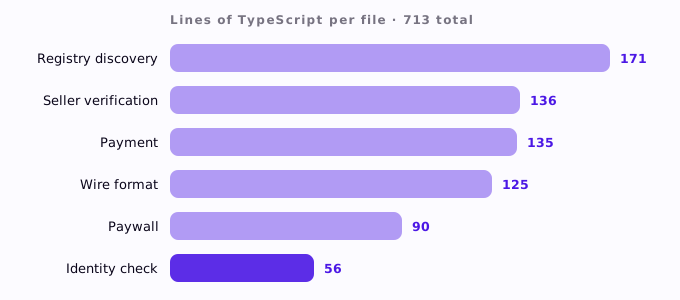
Everything is open source in the session-7 folder of MOI-Webinars:
- MOI — the chain; identity, registry, and settlement. Devnet explorer & faucet: voyage.moi.technology
- js-moi-sdk (docs) — wallets, MAS0 asset transfers, chain reads
- js-moi-agent-registry — registering agents and reading their cards, skills and wallets
- js-polo — POLO deserialization, used by the seller to decode transfer calldata straight off the chain
- Groq (console) running Llama 3.3 70B — both agents’ brains: market choice, demand pricing, worth judgment
- Node.js + TypeScript + tsx, in npm workspaces
- Express — the seller’s two routes: a free catalog and a paywalled answer
- Server-Sent Events — the live console that streams the buyer’s decisions as it makes them
- dotenv — one funded devnet mnemonic in
.env; the seller never needs gas, because it only ever receives
One design rule runs through all of it: models get judgment, code gets money. What to buy, what to charge, whether it’s worth it — model calls. Whether a payment is valid, who’s being paid, whether a transfer already bought something — arithmetic, signatures, and chain reads. A model can be talked into things; that’s a fine trait in a shopper and a fatal one in a cashier.
Built at Sarva Labs for the MOI Builders series. Earlier sessions cover the pieces this one stands on: the agent registry, native assets and swaps, and on-chain agent budgets.
What are agentic payments?
Payments where software agents decide, execute and verify the transaction themselves — discovery of the counterparty, pricing, identity verification, settlement and delivery, with no human approval per transaction.
Can an AI agent have its own crypto wallet?
Yes — each agent here has its own on-chain account and key, derived and held by the software. Honest caveat: in this demo both keys derive from one operator's seed, so the agents have their own addresses, not yet their own authority. Authority the agent inherits — rather than a key it simply holds — is what MOI's context inheritance adds.
What is HTTP 402 used for?
402 Payment Required has been reserved in the HTTP spec since 1997 for exactly this: telling a client that the resource costs money. Machine-to-machine payments are the first use case that genuinely needs it.
What stops the agent from overspending?
Today: only its own code — which is precisely the point of the closing section of the post. A per-purchase ceiling it sets for itself, removable with one environment variable, and no cap on cumulative spend. On-chain, chain-enforced budgets are Session 8.
What if the seller takes the money and doesn't deliver?
You lose it — the same as handing over cash. MOI exposes built-in lockup and release primitives that a pay-on-delivery flow could be built on, and that is on the roadmap beyond these sessions.
Are the bitcoin probabilities real forecasts?
No. The numbers are model-generated placeholders with no market data behind them, and every response says so in its payload. The demo is about the payment rails; swap in a real model and not a line of the payment machinery changes.
Can I run this myself?
Yes — one funded devnet wallet covers everything. Clone the repo at github.com/moi-foundation/MOI-Webinars, fund a wallet at the Voyage faucet (voyage.moi.technology), and npm run ui gives you the live console. There's a bounty for rebuilding it: both agents registered on MOI, a 402 quote, the identity check before payment, and a real transfer hash — submit your wallet, email and repo link at forms.gle/NToEMG47QHro9SiB8.
Get new posts by email
Protocol releases, research, and engineering write-ups from Sarva Labs. One email per post, nothing else.